

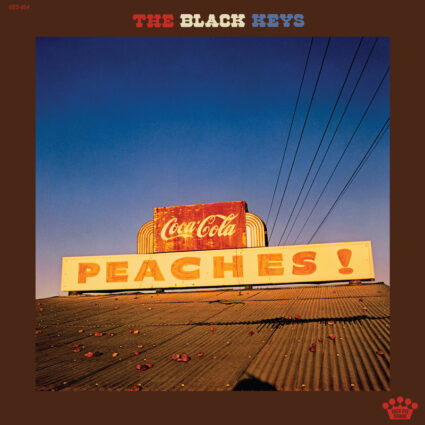
The Black Keys - Peaches!
The early days of 2025 were a dark time for Dan Auerbach. His father, Chuck Auerbach, had suffered a stroke the previous autumn, followed immediately by a diagnosis of esophageal cancer, and was staying in Dan’s Nashville home, in rapid decline.
Patrick Carney, Dan’s Black Keys bandmate and oldest, closest friend, knew without asking “that it would be good for Dan to have something to do.”
That something, of course, was music. The duo invited guitarist Kenny Brown, bassist Eric Deaton and multi-instrumentalist Jimbo Mathus (Squirrel Nut Zippers) to Dan’s Easy Eye Sound studio to crank up the amps and blow off some steam. The result, Dan says, is “the most natural Black Keys record since the first one, when I would bring in songs that we only half knew and just play ‘em.”
Peaches! is a visceral, intuitive ten-song collection that continues to expand the Black Keys’ quarter-century-long interpretation of blues-based rock ‘n’ roll. In a similar fashion to the early albums of their career, everything here was recorded live in the same room, unrehearsed, in one or two takes, with few overdubs.
“We weren’t making a record. We were just jamming, like this is for us,” Dan says. “Really primal, in a moment when all the nerves were raw, just kinda screaming. We were going through a lot, trying to lift our spirits. I think my dad getting sick made me not give a fuck and just wanna scream for a bit.”
The songs chosen for Peaches! reflect Dan and Patrick’s obsessive record-collecting habit, which in recent years has escalated into an ongoing series of Record Hang DJ-set dance parties. These hangs fueled a deeper period of musical archaeology for both of them. “I’d look for 45s specifically to play at the record hangs,” Dan says, “but sometimes I’d find a song and think, ‘This might be fun for Pat and me to play live.’”
After a couple of years, Dan had assembled a list of mostly obscure songs chosen specifically for the band. What began as a narrow focus on North Mississippi hill country blues, similar in spirit to Delta Kream, gradually widened to include music from across the United States and beyond. Along the way, Dan found himself rhapsodizing over George Thorogood and the Destroyers’ 1977 debut album, which opens with “You Got to Lose,” later reinterpreted as one of the Peaches! tracks. “It’s a badass song,” he says. “I’d never heard it before.”
“At the same time, we didn’t really reference the originals all that much,” Dan adds. “In most cases we completely disregarded them and forged our own path with the arrangements. It was an instinctive collaboration between me and Pat, Jimbo, Kenny, and Eric. I’d start playing the song, and then we’d all figure it out in our own voice, at our own tempo.”
Dr. Feelgood’s “She Does It Right” was sourced specifically from an online video of the band’s 1975 performance on the British television program The Geordie Scene. Where the original is defined by its UK protopunk speed-freak intensity and Wilko Johnson’s trademark finger-chop guitar style, The Black Keys’ version reimagines the song as an Akron basement boogie.
As the musicians recorded live, Dan would nod — and sometimes yell — to indicate changes. If Brown missed his effects pedal, Dan would reach over with his foot and stomp on it. The amps were loud, Dan says, “guitars bleeding unmercifully.” For one song, R.L. Burnside’s “Fireman Ring the Bell,” they set up two drum kits – Patrick on one and Kinney Kimbrough on the other – and bashed it out with the guitars wailing overhead.
“Yeah, all cut live in one room with no separation, including vocals,” says Patrick. “Only a few little overdubs like bells and shakers. It was a nightmare to mix but I think we got it sounding raw and filthy, but in a weird way hitting the hi-fi clarity in overall depth. It hits, but sounds really raw. It’s not hard on the ears like a lot of lo-fi, which I guess has always been our thing.”
“Shitty is pretty,” Dan adds.
After a period collaborating with outside songwriters and producers – including Beck, Noel Gallagher, and Dan the Automator on 2024’s Ohio Players and Rick Nowels, Daniel Tashian, and Scott Storch on 2025’s No Rain, No Flowers— this record took Dan and Patrick back to the spirit of the old basement in their hometown of Akron, Ohio, when it was just the two of them relying on their own wits. Patrick began mixing the album at his own studio – the first time he’d done so since 2006’s Magic Potion – before completing things with Dan back at Easy Eye Sound. The project also brought Michael Carney, Patrick’s brother, back into the fold. Michael art-directed all the early Black Keys albums, winning a Grammy for the Brothers cover. Peaches! is his first design since Delta Kream. Michael himself survived a massive stroke in 2019.
The cover of Peaches!, like that of Delta Kream, is illustrated with an image by William Eggleston, whom Patrick regards as “arguably the greatest living American photographer.”
Patrick discovered the image, a faded metal advertising sign with the word “PEACHES!” topped by a Coca-Cola logo, set against a deep blue evening sky. He knew it was the one he wanted, but “I didn’t think he’d let us use it. But like a lot of our career, it’s just shooting for the moon.”
So they asked. And he said yes.
Dan and Patrick had the opportunity to meet Eggleston at his Memphis home in late 2024.
“He’s a proper Southern gentleman,” Patrick says. “He has his nightly bourbon, dressed to the nines. It was very surreal to be with him for an hour.”
“We were in awe,” Dan continues, “just being able to get to be around some of these artists we respect so much and to be able to collaborate with them and watch them contribute in a meaningful way to our legacy.”
The spring release will be followed by a tour which, like the recording of Peaches!, will be done on the duo’s own terms, following old instincts. They’ll be playing venues with open floors, allowing their most avid fans equal access to the front of the stage, rather than the highest bidders in the ticket market. They’re eager to play the new material for their fans. And to be sure, they do consider this material “new.”
“I don’t want this to be perceived as a covers record,” Dan says. “It’s so much of a retelling that to call it a covers record would be to oversimplify it. I want it to be perceived as a great Black Keys album. I want a lot of people to say it’s their favorite. I think a lot of people will, too.” – By David Giffels